Small One-Car Garage Organization Plan (Zone Layout)
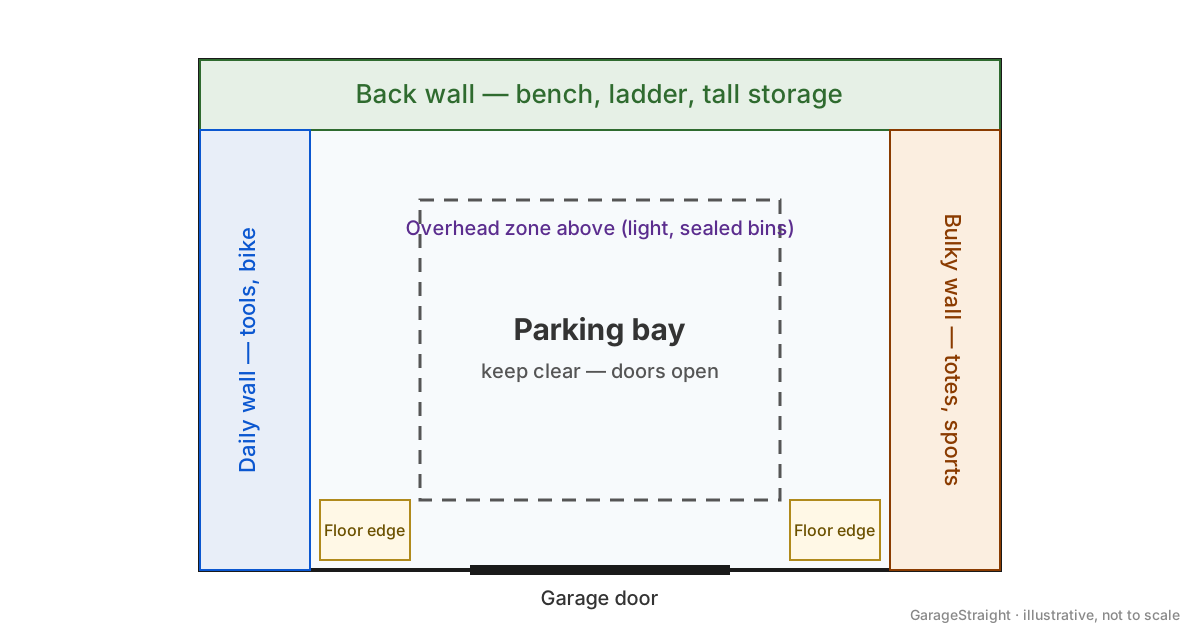
A one-car garage fails the same way every time: the parking bay shrinks until the car lives on the driveway. The fix is not “buy more bins.” It is a zone plan that protects vehicle clearance first, then assigns every category of stuff a home that does not fight the doors.
This guide walks through a simple layout you can sketch in an afternoon. Use it with the free garage zone layout planner and, before anything goes above the car, the overhead rack weight calculator.
What “small” usually means
Exact dimensions vary by era and builder, but many one-car bays land roughly in the 10–14 ft wide by 18–22 ft deep range. What matters more than the label on the realtor sheet:
- Vehicle envelope — length, mirrors, and how far doors open.
- Door travel — sectional overhead doors need clear tracks; side-hinged doors need swing space.
- Work habits — if you wrench weekly, the bench earns a permanent wall; if you only store, prioritize vertical storage.
Measure once with a tape: bay width, depth, ceiling height under joists or trusses, and the highest point on the vehicle you actually park there. Write those numbers down before shopping.
The five zones (and what belongs in each)
Think in zones, not in random hooks.
1. Parking bay (sacred)
Nothing permanent belongs in the rectangle the car needs. No freestanding cabinets that force a three-point turn. No floor piles “just for the weekend.”
Leave margin beyond the car’s footprint for:
- Opening driver and passenger doors
- Walking past the nose or tail without climbing over totes
- Door hardware and opener rails
If a product only fits by shaving that margin, it does not fit.
2. Left and right walls (daily vs bulky)
Pick a daily wall and a bulky wall.
- Daily wall: hand tools, charging cables, bike you ride often, broom, vacuum. Keep the most-used items between roughly shoulder and knee height.
- Bulky wall: lumber offcuts, camping tubs you open quarterly, sports gear bags, a folded table.
Studs make wall systems easier; masonry needs the right anchors — follow the hardware manufacturer and, if unsure, ask a pro. For the wall-system decision itself, see slatwall vs pegboard.
3. Back wall (deep storage + bench option)
The wall opposite the vehicle door is usually the deepest uninterrupted run. Good uses:
- A shallow workbench with pegboard or slatwall above
- Tall cabinets only if they do not eat door swing or block a walkway
- Ladder hangers that keep rails off the floor
Avoid turning the back wall into a second driveway pile. Vertical storage beats a second row of floor totes.
4. Overhead / ceiling (light, sealed, infrequent)
Overhead storage is for light, sealed, rarely accessed items: holiday decorations, archive bins, empty luggage. It is not for paint thinners, spare fuel, or anything that must come down weekly.
Before loading a rack:
- Read the manufacturer’s published load rating.
- Confirm mounting instructions for your framing type.
- Run your planned contents through the weight calculator.
- Read overhead garage storage weight limits for context on ratings vs joists.
Safety: this site does not calculate joist capacity. If you do not know what you are fastening into, hire a qualified professional.
5. Floor edge (seasonal machines, not clutter)
Snow blowers, mowers, and large wheeled tools often need floor space. Give them a defined strip along a wall that stays outside the parking envelope. Use a painted line or tape if it helps the household respect the boundary.
Do not store chemicals where a tipped bottle can run under the car or toward a floor drain without a tray.
A sample one-car layout (illustrative)
The diagram on this page is a teaching sketch, not a permit drawing. A common pattern:
| Zone | Example contents |
|---|---|
| Daily wall | Hand tools, bike, charging, cleaning |
| Opposite wall | Sports bags, seasonal totes (waist height), hose reel |
| Back wall | Bench + small parts, ladder |
| Overhead | Holiday bins, archive boxes (within rack rating) |
| Floor edge | Mower or snow blower, closed chemical cabinet if needed |
| Parking bay | Car only |
Adjust for a side door, a freezer, or a washer — those appliances become permanent “furniture” and steal wall length, so something else must go vertical or leave the garage.
Workflow: clear → zone → hang → load
- Empty a path, not the whole garage at once. Pull everything out of the parking bay first so the car can return each night.
- Sort into keep / relocate / trash-recycle. Cardboard that lived in the garage for two years is not inventory; it is humidity food.
- Assign zones on paper or in the zone planner. Name the item and the zone before you buy a single bracket.
- Install wall storage before overhead when possible. Walls are easier to revise; ceilings punish mistakes.
- Load overhead last, lightest bins toward the edges if the manufacturer allows, labels facing the aisle.
- Budget with real numbers in the cost estimator — enter prices from carts you actually open; ignore invented “average” costs.
Budget sequencing (without fake price claims)
People ask what a full garage “should” cost. Honest answer: it depends on region, whether walls are finished, and whether you choose plastic hooks or a full cabinet run. Instead of a fake national average:
- Phase A — $0–low: trash/recycle, labels, relocate non-garage items indoors or to donation.
- Phase B — wall hooks & shelves: highest use-per-dollar for most one-car bays.
- Phase C — overhead rack: only after you know clearance and rating.
- Phase D — cabinets: buy when the zone plan is stable, so doors do not fight bikes or the mower.
Use the cost estimator with your quotes. Product cards on this site marked TODO are not live offers.
Common one-car failure modes
- Floor cabinets in the parking envelope. They look tidy in photos and ruin daily parking.
- Pegboard overloaded with dead weight. Pegboard is handy for light tools; it is not a lumber rack. Details in the slatwall vs pegboard comparison.
- Overhead as attic 2.0. If you need a ladder every weekend, that category belongs on a wall.
- No label system. Opaque bins without labels become a second junk drawer in the sky.
- Ignoring door tracks. Storage that collides with opener rails or torsion hardware is a safety issue — stay clear per manufacturer guidance.
Midwest / seasonal note
If you store a snow blower half the year and a mower the other half, treat that floor-edge slot as a rotating lease. The off-season machine can sometimes go to a shed or a deeper back corner — but only if it still leaves a walk path. Holiday bins earn overhead space; salt and liquids belong in sealed containers on a tray, not above the car.
Checklist before you buy hardware
- Parking bay measured with doors open
- Zones assigned for every keep category
- Wall type known (studs, blocking, masonry)
- Ceiling height and vehicle roof clearance checked
- Manufacturer ratings read for any overhead product
- Weights estimated in the calculator
- Budget lines filled with real quotes in the estimator
Related reading
- Overhead garage storage weight limits
- Slatwall vs pegboard for garage walls
- All GarageStraight tools
Get the zones straight first. The products are easy to shop once the parking bay is non-negotiable.