Slatwall vs Pegboard for Garage Walls
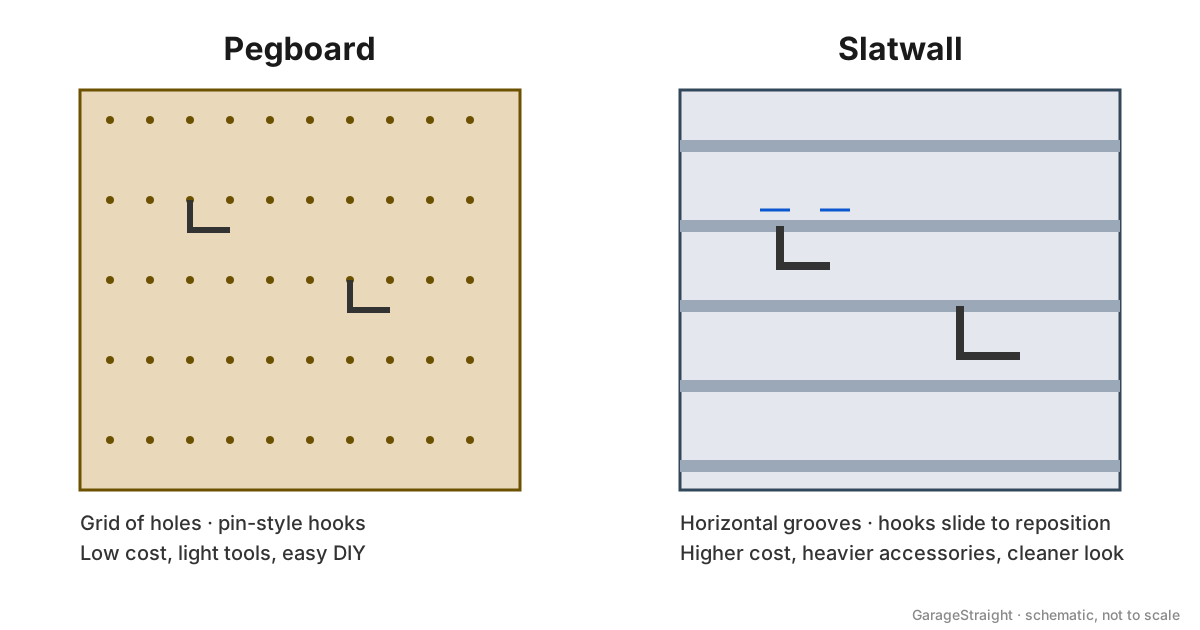
Pegboard is the classic garage wallpaper. Slatwall is the cleaner, often pricier cousin you see in showrooms. Both can organize a wall — and both can disappoint if you pick them for the wrong job.
This comparison stays practical: how each system holds things, how annoying it is to rearrange, what walls they like, and when to skip both. It does not invent lab test rankings, “winner” scores, or hands-on reviews of specific SKUs we have not verified.
For the bigger layout context, read the small one-car garage organization plan. For anything going above the car, use the overhead weight calculator and the weight-limits guide — wall systems and ceiling racks solve different problems.
Quick definitions
Pegboard (also called perforated hardboard or metal peg panels) is a sheet with a grid of holes. Hooks, bins, and brackets insert into those holes. Spacing is fixed by the grid.
Slatwall (horizontal groove wall panels) uses continuous channels. Accessories hang from those grooves and usually slide sideways to reposition without pulling out of a single hole.
Track systems and French-cleat walls are cousins; this article focuses on the pegboard vs slatwall decision most shoppers mean when they type the comparison query.
Decision criteria (no fake scores)
| Criterion | Pegboard tends to win when… | Slatwall tends to win when… |
|---|---|---|
| Upfront cost mindset | You want the cheapest covered wall for light tools | You will invest more for fewer visible holes and heavier accessories |
| Reconfiguration | Occasional moves are fine | You rearrange hooks often and hate hunting for empty holes |
| Load style | Screwdrivers, pliers, small kits | Bulkier hangers, baskets, bikes on rated accessories |
| Aesthetics | Workshop look is OK | You want a showroom-ish wall |
| DIY forgiveness | Simple panels over studs | You are willing to follow panel fastening patterns carefully |
None of those rows is a universal law. A heavy-duty metal peg panel with short spans can outperform a poorly fastened decorative slat panel. Mounting quality beats marketing category.
Pegboard: strengths and limits
Strengths
- Familiar and widely available. Hooks are easy to find.
- Good for dense small-tool layouts. Outlines drawn around tools still work culturally for a reason.
- Easy to try above a bench. A single sheet can prove whether you will actually hang tools before you clad an entire wall.
Limits
- Hole grid constraints. Accessories want empty holes in the right pattern; crowded boards become a puzzle.
- Material matters. Thin hardboard over long spans can sag or tear at holes if overloaded. Metal peg panels behave differently — read the product’s own guidance.
- Look. Some households love the industrial grid; others see visual noise.
Pegboard is rarely the right answer for lumber storage, tire racks, or other dense loads. Those belong on properly rated shelves, floor zones, or overhead systems with documented capacities.
Slatwall: strengths and limits
Strengths
- Horizontal freedom. Slide a hook two feet left without dismantling a constellation of pegs.
- Accessory ecosystem. Baskets, shelves, bike hangers, and cabinets often share a groove language within a brand family (stick to compatible lines).
- Cleaner face. Grooves read calmer than a full hole grid when the wall is visible from the house.
Limits
- Cost. Panels plus branded accessories usually outspend a basic pegboard starter kit. Use the cost estimator with your cart prices — do not trust invented “average install” figures.
- System lock-in. Mixing random hooks from another brand can fit poorly or overload a groove.
- Install discipline. Panels need fastening into structure on the pattern the maker specifies. Foam-looking inserts and fancy finishes do not replace studs or proper anchors.
Wall substrate checklist (both systems)
Before either product goes up:
- Find studs or confirm masonry anchors appropriate to the fastener.
- Note electrical wires and plumbing — do not guess with long lags.
- Plan height bands: daily tools near shoulder/waist, rare items higher, never blocking door tracks.
- Leave the parking bay alone — wall storage that forces the car sideways has already failed. Sketch zones in the layout planner.
Masonry and metal buildings need different anchors than wood studs. When the manual and your wall disagree, stop and ask a pro.
Load honesty without fabricated ratings
Manufacturers sometimes publish accessory ratings (for example, a hook rated for a stated load when installed as directed). Treat those like overhead rack numbers:
- They apply to that accessory + that install
- They do not certify crumbly drywall alone
- They are not GarageStraight lab results
We will not invent comparative pound ratings between “typical pegboard” and “typical slatwall.” If a listing refuses to state capacity for a bike hanger, walk away or verify with the maker.
Hybrid strategies that work in one-car garages
You do not have to marry one system for life.
- Pegboard above the bench, slatwall on the long side wall for seasonal baskets.
- Slatwall for bikes and bulk, pegboard for small hand tools only.
- Open shelves + a short peg strip when you mostly store labeled bins, not dangling tools.
- Cabinets for chemicals and visuals, hooks only for what must air-dry or stay visible.
The one-car organization plan treats walls as zones first; the panel product is a finishing choice inside a zone.
Cost planning without made-up prices
People want a single number: “slatwall costs $X per bay.” Retail and labor vary too much for a responsible static site to publish a fake national average.
Instead:
- Measure square footage of wall you will cover.
- Price panels and the actual accessories you need (hooks are where totals creep).
- Add fasteners and any furring or plywood backing your install requires.
- Enter lines in the cost estimator. Reload example defaults only as editable illustrations, then replace every dollar amount.
- Compare that total to a “hooks + shelves only” alternative — sometimes you do not need full-wall cladding.
Placeholder product cards below are TODO affiliate slots, not live offers.
When to choose neither (yet)
Skip buying panels if:
- The parking bay is still a junk pile — sort first
- You have not decided daily vs bulky walls
- Moisture is destroying cardboard on the floor (fix water first)
- You mainly need overhead clearance for seasonal bins (solve ceiling storage with rated racks, not more wall hooks)
Practical recommendation framework
Ask three questions:
- What am I hanging? Mostly light hand tools → pegboard is often enough. Bikes, heavy baskets, frequent rearranging → lean slatwall or a rated track system.
- Will guests see this wall? If yes and aesthetics matter, slatwall’s cleaner face may be worth the spend.
- Am I willing to buy into one accessory family? If not, pegboard’s generic hooks may frustrate less.
Then run the zone planner, budget with real quotes, and only after that click any shopping link — including future GarageStraight affiliate links once Revenue fills the placeholders.
Related reading
Bottom line: pegboard wins on simple light-tool walls and low commitment; slatwall wins on reconfiguration and heavier accessory ecosystems when installed per spec. The “best” wall is the one that keeps the car’s envelope clear and matches how you actually grab tools on a Tuesday night.