Overhead Garage Storage Weight Limits (Joist & Rack Guide)
Overhead garage storage fails in headlines for a reason: gravity is patient, and a rack that “felt fine” for a year can still be the wrong answer for the framing above it. This guide explains what published weight ratings actually mean, how to plan the weight of what you store, and where a homeowner should stop and call a professional.
It does not tell you how many pounds your joists can hold. That is structural judgment. GarageStraight’s overhead rack weight calculator only compares your item list to the rack rating you type in.
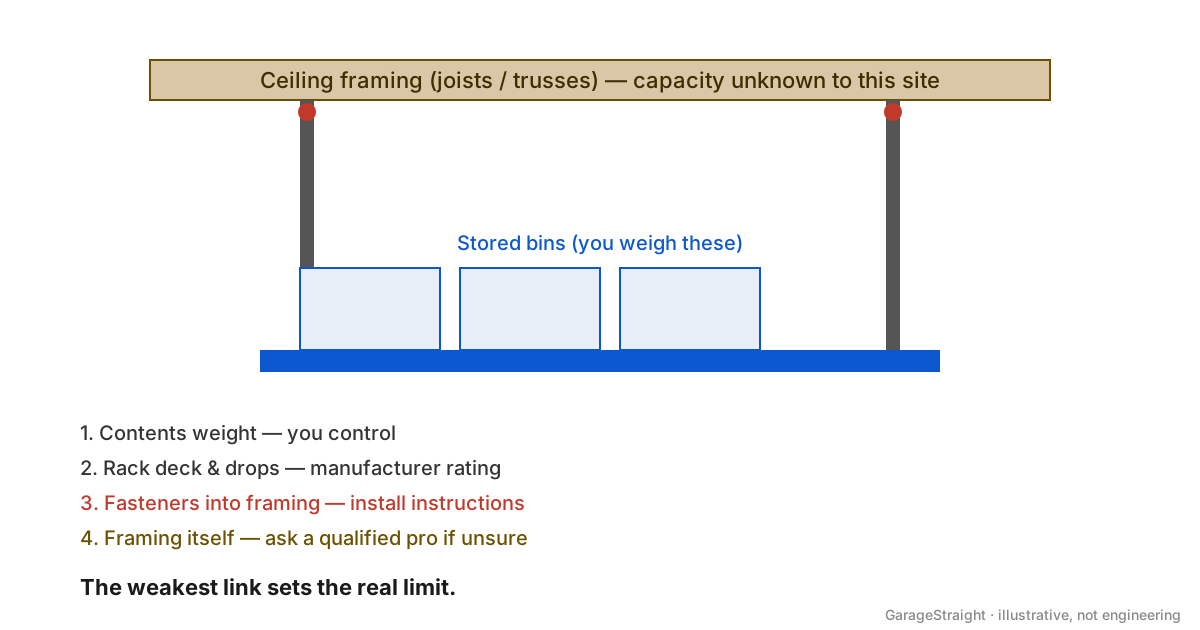
The load path (weakest link wins)
Every overhead setup is a chain:
- Contents — bins, lumber, tires, luggage
- Rack structure — deck, rails, uprights or straps
- Fasteners & brackets — lags, bolts, hangers as specified
- Building framing — joists, trusses, or a rated anchor point
The safe load is never higher than the weakest link. A rack labeled for hundreds of pounds does not upgrade undersized fasteners or unknown truss chords. Conversely, stout framing does not raise a rack past its manufacturer rating.
Keep that chain in mind while you read marketing pages. “Heavy duty” is not a number.
What a manufacturer rating usually covers
When a reputable maker prints a capacity (for example on a label, manual, or spec sheet), treat it as:
- A limit for that product, installed as directed
- Often assuming specific fastener sizes, spacing, and substrate (wood joist species/size, concrete, etc.)
- Sometimes a total load for the whole unit, sometimes a per-pole or per-section limit — read the fine print
Ratings typically do not:
- Certify your particular house framing
- Account for dynamic loads (someone climbing on the rack, swinging a ladder into it)
- Excuse mixing random hardware from the junk drawer
- Replace local code or permit requirements where they apply
If the manual says “into solid wood joists” and you have open-web trusses, stop. Truss manufacturers often restrict where you may drill or hang loads. That is a professional question, not a blog-post guess.
Planning contents weight (the part you control)
You can be rigorous about bins without pretending to be an engineer.
- List each item or bin you intend to store overhead.
- Weigh them on a bathroom or shipping scale, or estimate conservatively from labeled package weights.
- Add a little for lids, straps, and the fact that “empty” bins collect stuff.
- Enter the list in the weight calculator.
- Choose a usable budget below 100% of the printed rating (the calculator’s 70–90% factors) so uneven loading and future additions do not pin you at the ceiling of the label.
Heavy categories that often surprise people:
- Paper archives and books
- Liquid containers (even sealed)
- Tool cases with metal contents
- Sporting gear with dense components
Light, sealed holiday decorations are the classic good fit — if they truly stay light.
Clearance, balance, and access
Weight is only one constraint.
- Vehicle roof and door tracks: Measure with the car in place if you can do so safely. Leave margin for roof racks and for the garage door’s travel.
- Balance: Piling all the dense bins on one end of a rack can overload one hanger even when the total is under the label. Follow any manufacturer guidance about distributed loads.
- Access frequency: If you need it monthly, it may not belong overhead. Put frequent items on a wall zone instead — see the one-car organization plan.
- Fall hazard: Never store glass jars of chemicals or anything that becomes dangerous when dropped above a parking bay.
Joists, trusses, and “hire a pro” territory
Homeowners often ask, “My joists are 2xsomething — how much can I hang?” Honest answer from a content site: we will not invent a number.
Reasons to get a qualified contractor, structural engineer, or (where appropriate) inspector involved:
- You cannot identify the framing member or its span/condition
- You have engineered trusses with stamped restrictions
- You want to hang near mid-span on long joists with existing notches/holes
- There is water staining, insect damage, or prior ad-hoc hanging everywhere
- Local rules require permits for the work you plan
A careful installer reads both the rack manual and the framing situation. Skipping either side is how racks become cautionary tales.
Installation habits that protect the rating
Without turning this into a how-to that overrides your manual:
- Use the fastener type and length the manufacturer specifies for your substrate.
- Hit the structure they call for — not drywall alone, not random plywood scraps unless the design says so.
- Mind spacing between hangers; stretching a kit “to fit” can void the assumptions behind the rating.
- Recheck fasteners after the first seasonal temperature swing if the manual recommends it.
- Label bins with weights if you share the garage with family members who might “just add one more.”
How GarageStraight’s calculator fits
The overhead rack weight calculator asks for:
- The manufacturer rating you supply
- A usable budget factor you choose
- Line items with quantity and weight each
It outputs whether your planned contents fit that budget. It will not:
- Approve your joists
- Replace the manual
- Generate a sealed drawing
Pair it with the zone layout planner so overhead only receives categories that deserve to be up there, and with the cost estimator when you are ready to price a rack using your retailer quotes — not invented averages.
Affiliate and shopping notes
When you eventually buy a rack, prefer clear documentation: capacity in pounds, mounting diagrams, and support contacts. Placeholder product cards on this page are not live affiliate links; Revenue will replace them after programs are approved. Until then, treat shopping links elsewhere on the web as research, and verify ratings on the manufacturer’s own materials.
Worked example (illustrative numbers only)
Suppose your rack’s manual states a total capacity you will type into the calculator yourself — for this walkthrough, imagine you read 600 lb on the label (replace with whatever your label says).
You plan four sealed bins:
| Bin | Scale weight each | Qty | Subtotal |
|---|---|---|---|
| Holiday décor | 22 lb | 2 | 44 lb |
| Camping gear | 35 lb | 1 | 35 lb |
| Archive paper | 40 lb | 2 | 80 lb |
| Empty luggage | 12 lb | 2 | 24 lb |
Total contents ≈ 183 lb.
If you set the calculator’s usable budget to 80% of a 600 lb label, usable budget = 480 lb. You are well under that budget on paper — but you still must confirm the manual’s rating applies to your substrate, distribute bins so one hanger is not doing most of the work, and refuse to “top off” with paint cans later without re-running the math.
If the archive bins were 70 lb each instead, the story changes quickly. Re-weigh when contents change. The calculator is cheap insurance; climbing a ladder to discover a soft joist is not.
What not to store overhead
Skip or relocate:
- Fuels, solvents, and pressurized cylinders
- Anything that must stay cool or freeze-protected unless the product is rated for garage temperatures
- Items you need during a power outage in the dark (keep a ground-level kit)
- Open trays of fasteners that become shrapnel if a corner fails
Wall zones from the one-car plan absorb most of those categories better.
Red flags when shopping
Be skeptical of:
- Capacity claims with no manual PDF or dimensional drawing
- Photos that show racks hung from drywall alone
- “Universal” hardware kits that ignore joist spacing
- Used racks missing labels — you cannot verify the rating
Choose documentation over vibes. Placeholder CTAs on GarageStraight are waiting for real affiliate URLs; they are not endorsements.
Quick FAQ
Can I convert cubic feet of bins to pounds? Only if you know density. A bin of foam wreaths and a bin of books are not cousins. Weigh them.
Is steel always stronger than the wood above it? The rack can be the strong link and still be limited by framing or fasteners. The strongest-looking part is not automatically the limit.
Do I need a permit? Depends on locality and scope. When in doubt, ask your building department before drilling a forest of holes.
Can GarageStraight tell me my joist grade? No. We will not invent spans, species, or allowable loads.
Related reading
Bottom line: respect the printed rack rating, be honest about bin weights, leave margin, and treat framing questions as professional work. Getting the weight story straight is how overhead storage stays boring — which is exactly what you want above a car.